Synchron Titanium Ti300M
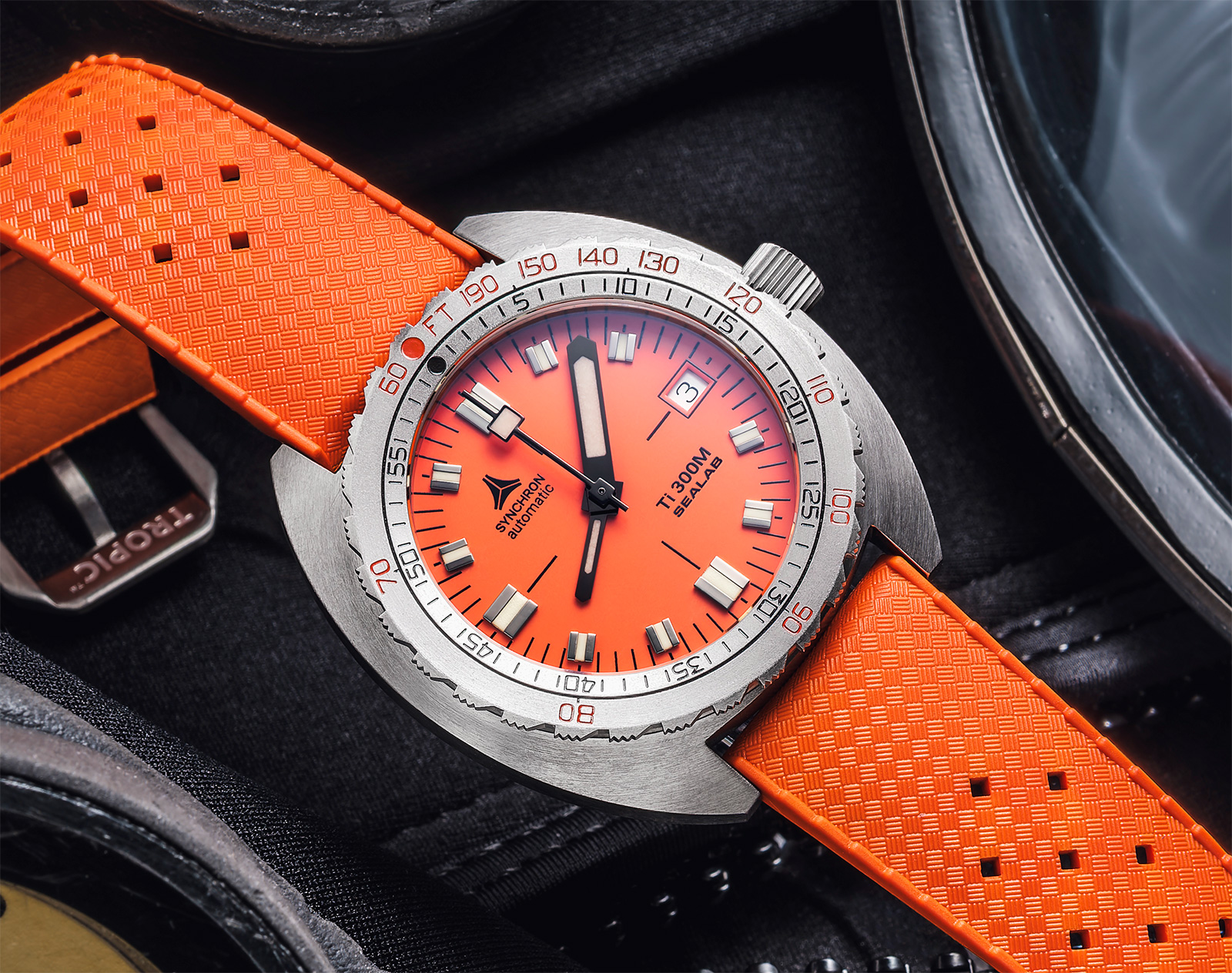
Let me ask those people reading this a question. How many of you like Titanium watches? Counting…1, 7, 25, 60, 100, 150, 240, 375…. OK I’ll stop there. Obviously a lot. And that is one of the reasons why Synchron released the Ti300M. People had been asking DOXA for one for a while and with no response they started asking Synchron. Here it is. Ladies and gentlemen, may I present the Synchron Ti300M SEALAB.
Before I continue, I want to give people a history lesson.
There is no doubting that the design language saying that the Ti300M is based on a DOXA SUB, punches you right in the face, but that’s what it is supposed to do. People will say it is an homage to the SUB 300T, and rightly so, Synchron acknowledge that in the marketing material for the watch. But here’s something you may not know.
In 1969, the Swiss watch industry was in turmoil and consolidation was the name of the game. Chronos Holding SA had been created in 1966, to manage new acquisitions, including the recently defunct CYMA and Tavannes brands, as well as taking a stake in Gruen. On December 18, 1968 Chronos Holding formed another holding company known as Synchron S.A. using another failing brand: Ernest Borel. In 1969 the Synchron group consolidated with the absorption of CYMA and DOXA. This was believed to have been completed on March 27th of that year. All of the members of the Synchron group were venerable Swiss brands with a long history of innovation and accomplishments, but like many other brands they had fallen on hard times. Being part of the Synchron group allowed production economies of scale and combined marketing and staved of bankruptcy for the 3 companies.
The Synchron Era lasted almost 10 years and the classic SUB design changed little other than becoming thicker and using an improved bezel with longer minute marks. Because of the number of SUBs produced during those years there are more vintage Synchron DOXAs than there are pure DOXAs and by that I mean:
The Synchron Era DOXAs were actually Synchron watches. The majority had the Synchron logo on the dial, the Synchron logo on the crown, the Synchron logo on the caseback and the Synchron logo on the bracelet clasp. The movement rotor said Synchron. The caseback and packaging also said “by Synchron”. The only place the word DOXA appeared was on the dial.
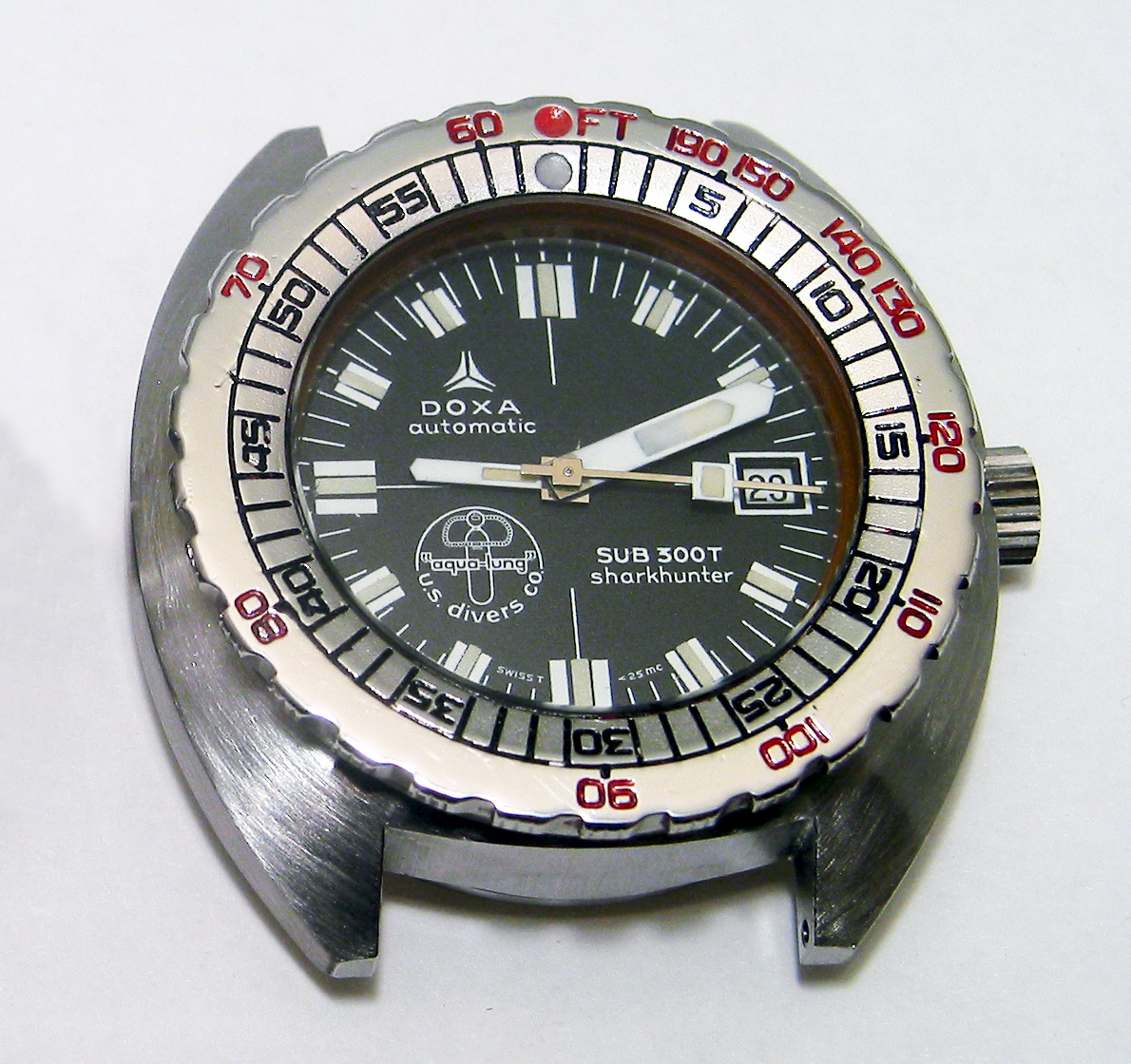
This image shows a 3rd generation Synchron SUB 300T. The watch has the “beefier” bezel with the larger minute marks and the Synchron logo on the dial.
So, it could be argued that if anyone has the moral high ground to make a SUB homage, it is Synchron. The extra irony is that Synchron is now owned by Rick Marei and as most people know, it was Rick who resurrected the DOXA SUB in 2002.
At the end of the day, this is a Synchron, not a DOXA. If people want the full flavor DOXA SUB then they should buy one. They are tremendous watches….. I should know, I’ve owned almost forty of them over the years ….. but at the time of writing you won’t able to buy a titanium version.
OK, now that’s out of the way, let’s get on with the review. There is however, one thing I must make clear. This is a prototype watch and the dial uses a name which is not SEALAB. Synchron considered different names for the watch and made dials up with the different options before settling on SEALAB. This prototype has one of those other dials. I’ve photoshopped the name out of my images, because the name will be used in a future release and I don’t want to give the game away.
Titanium is a bit of a departure from the usual steel cased watches Synchron has produced in the past. Dimensionally, the Ti300M is also a bit of a swerve from the standard 42mm case width traditionally associated with a vintage SUB.
Right, now let’s take a look at a comparison table.
| WIDTH (mm)
(without crown) |
LENGTH (mm) | HEIGHT (mm) | LUG WIDTH (mm) | WEIGHT (grams)
(with bracelet for 6.75″ wrist) |
|
| SYNCHRON Ti300M | 41 | 44 | 11.9 | 20 | 88 |
| AQUASTAR BENTHOS H2 | 40 | 45 | 12.3 | 20 | 157 |
| DOXA SUB 300T | 42.5 | 45 | 14 | 20 | 173 |
| SEIKO MONSTER | 42.5 | 47.5 | 13 | 20 | 166 |
| SYNCHRON Ti300M – SEIKO BRACELET | 41 | 44 | 11.9 | 20 | 88 |
| SYNCHRON POSEIDON | 42 | 45 | 14.7 | 20 | 153 |
| ROLEX GMT | 43 | 47 | 13 | 20 | 135 |
| DOXA SUB 750T | 45 | 47 | 13.7 | 20 | 177 |
| SYNCHRON Ti300M HEAD ONLY | 41 | 44 | 11.9 | 20 | 50 |
| DOXA SUB 300T HEAD ONLY | 42.5 | 45 | 14.5 | 20 | 92 |
The Ti300M does not come with a titanium bracelet, although one may be produced for it, so I added a spare titanium bracelet to it in order to give a reasonable comparison of weights. The alternative was to just remove every bracelet and weigh the watch heads but I didn’t feel it gave a true representation of the watch because all these watch use different bracelets and that can affect the overall weight.
I had hoped that I could file the endpieces down on the titanium to make it fit, but unfortunately the springbar holes don’t align.
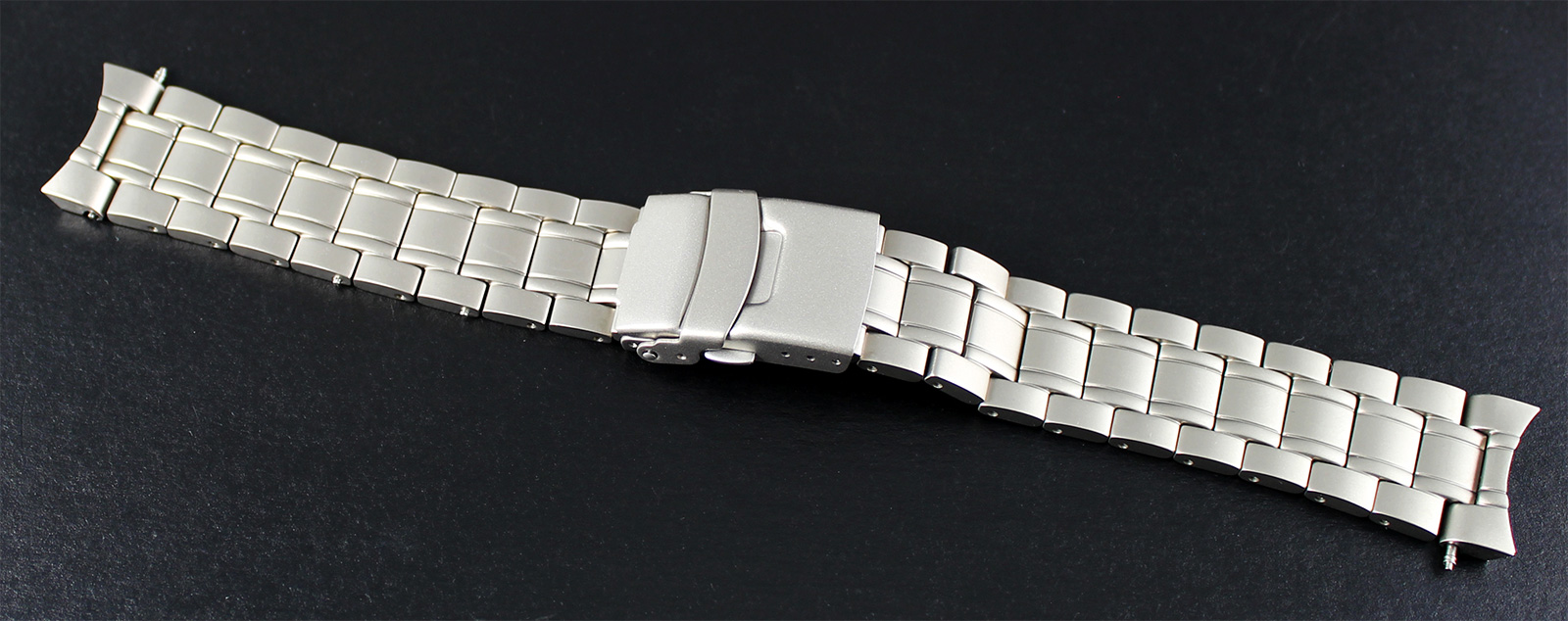
I know some people reading this will ask themselves whether a Maranez titanium bracelet would fit. Bad news on that front. The larger Samui endpiece does fit. Bit of jiggling about with the small 1.3mm pins but it will attach as the holes almost line up. However, it is just too tall. The smaller Samui Vintage endpiece is a bit too small, but it is impossible to attach as the pin holes in the case are covered by the sides of the endpiece.
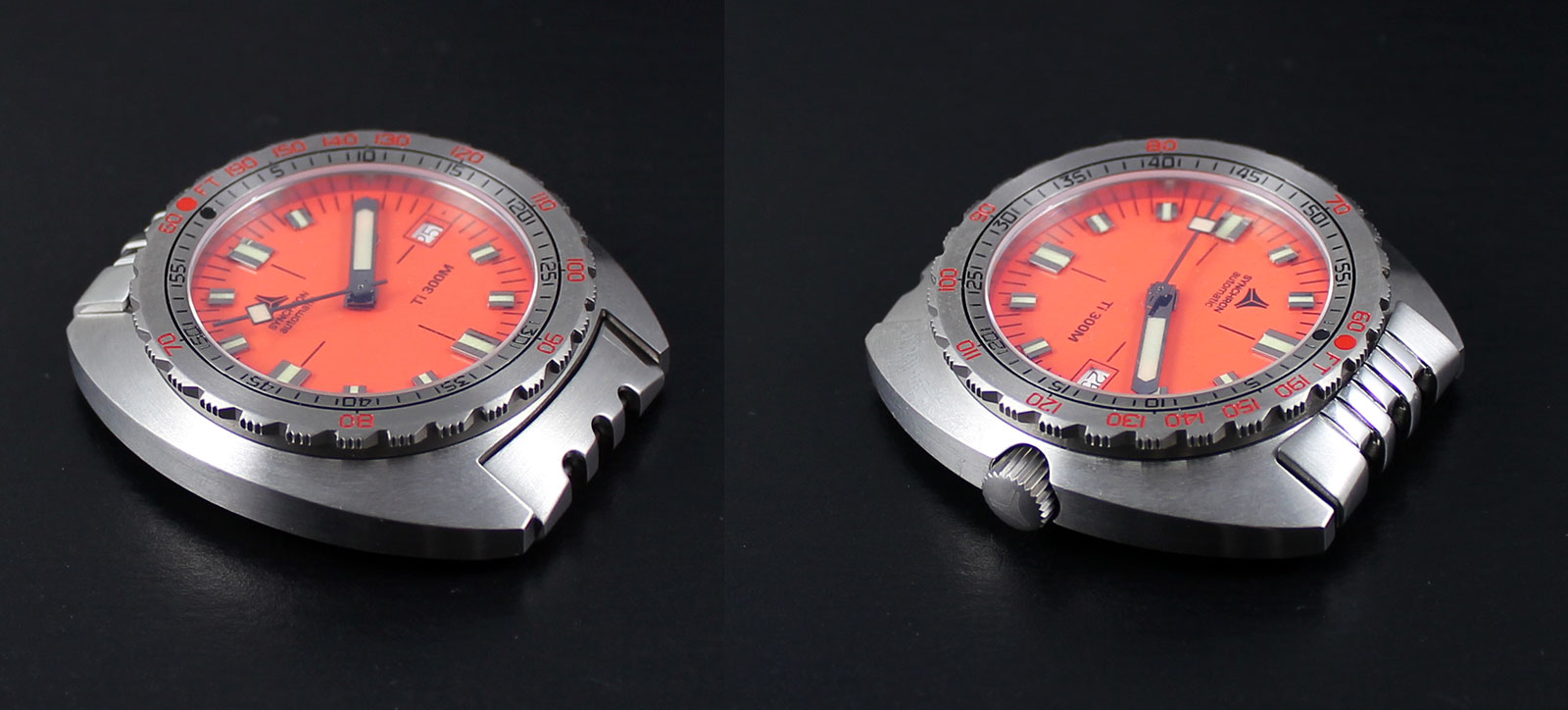
However, I did try a couple of the thin and light steel bracelets I have and found an absolute winner in a vintage Seiko bracelet.
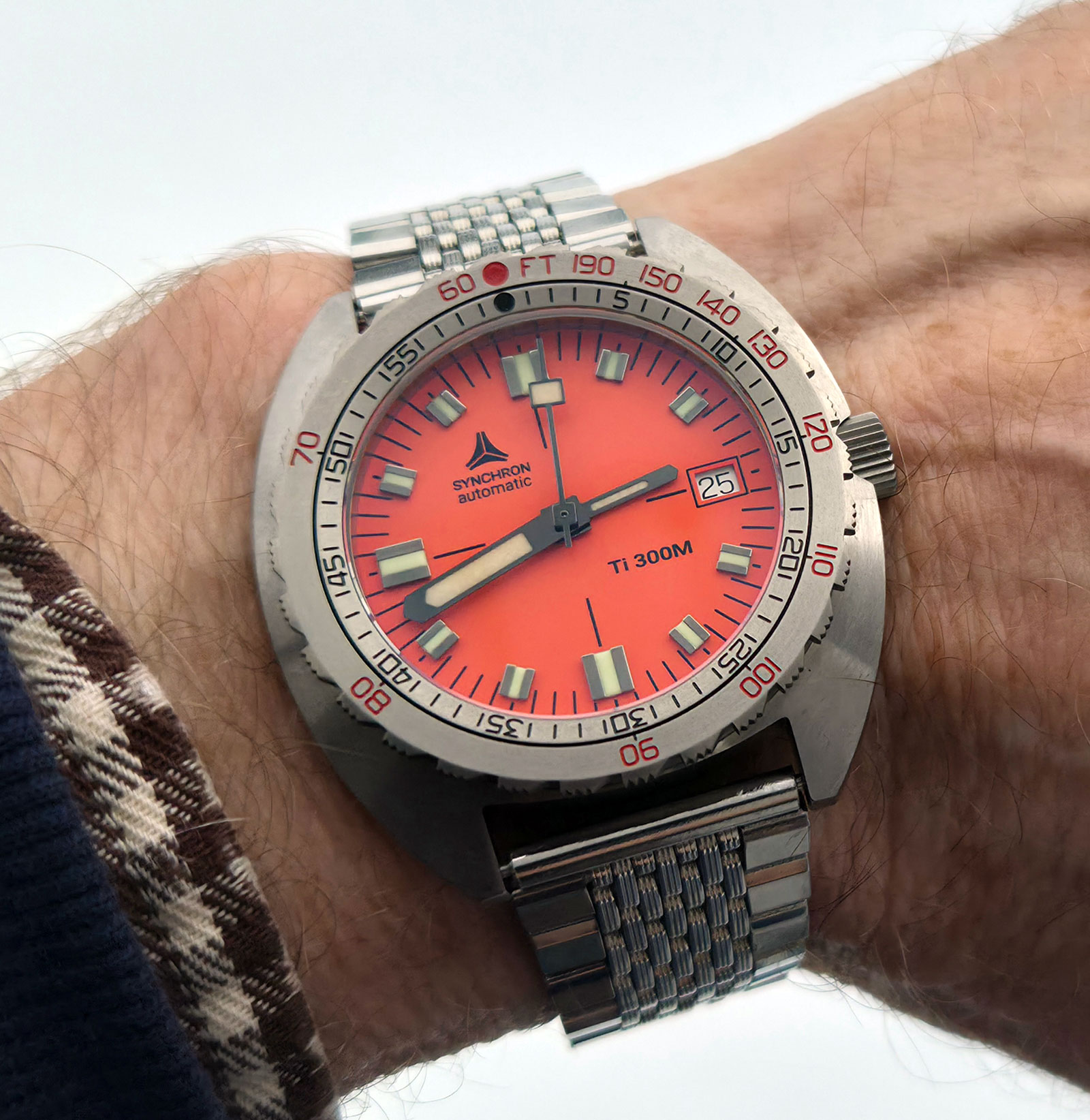
What a transformation. I can’t wear straps for very long as they irritate my skin so I’m a bracelet guy. I’ve never been a fan of titanium watches, basically because of the bracelet. I just think they have a terrible sound and weird rattle. Also I found that depending on the crown design and caseback logo, the edges could feel a little sharper than those on steel watches. That’s what put me off the 3 titanium watches I’ve owned. Sold them quickly. However, having now tried 2 thin and light steel bracelets on the Ti300M, I’m changing my mind on the whole titanium watch thing…… I’m beginning to see why people like them. What really was a shocker for me is the weight of the Ti300M and the titanium bracelet I have (sized for m 6.75 inch wrist) weighs the same as the Ti300M and my vintage steel Seiko bracelet.
And that brings me to wearability. I’m gobsmacked at just how nice this watch wears on a bracelet. I have several wear and forget watches. Put them on and they just disappear. The Ti300M not only disappears when you wear it. I forgot I even put it on!!!!
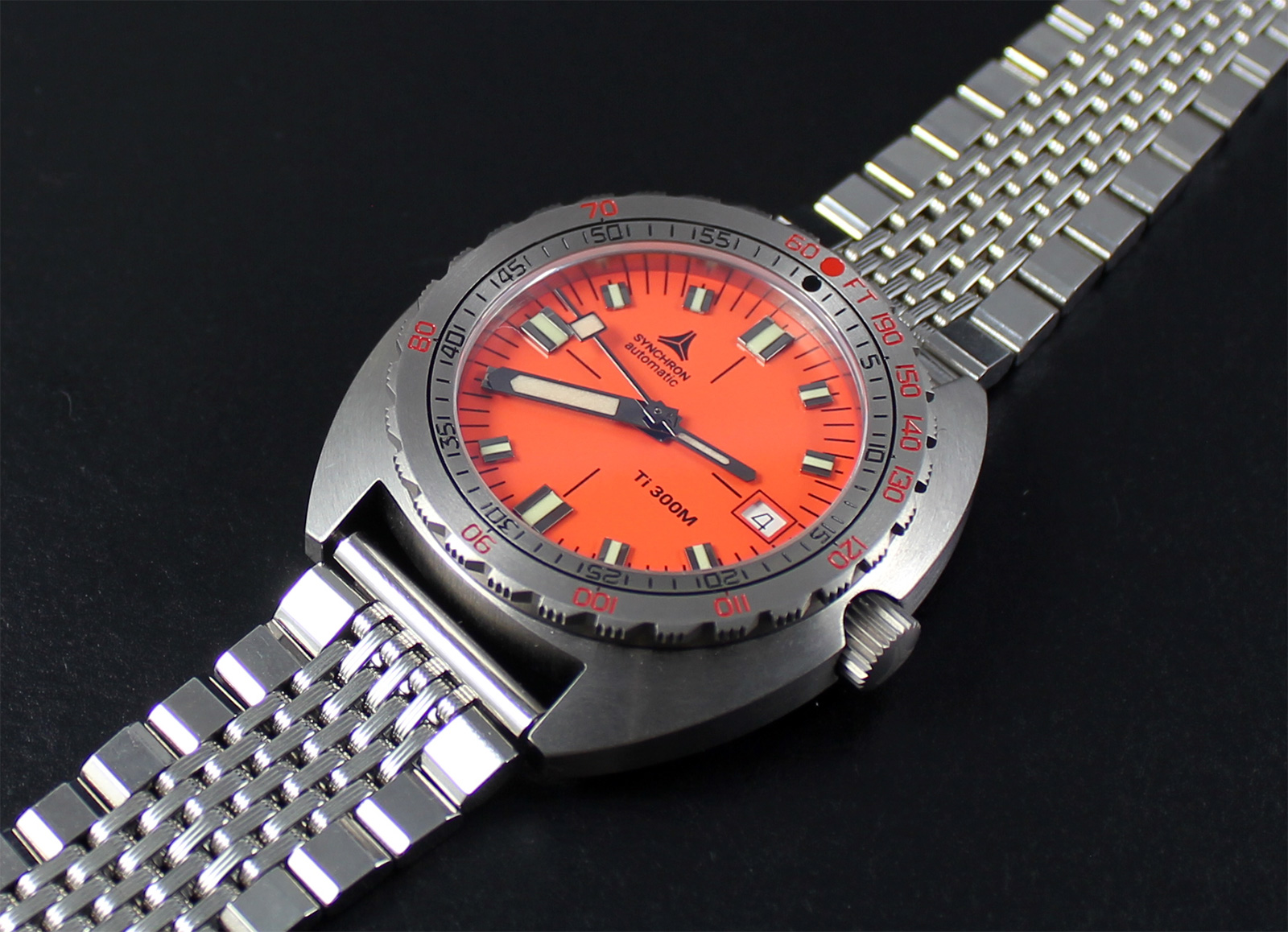
The Ti300M comes on a strap but Synchron have hinted that they may make a fitted titanium bracelet available for the watch. In the interim I’d be going down the route of getting hold of a thin steel bracelet and just brushing it if polished. As I already mentioned, the Seiko one I’m using adds no extra weight compared to the titanium one I used in the weight table.
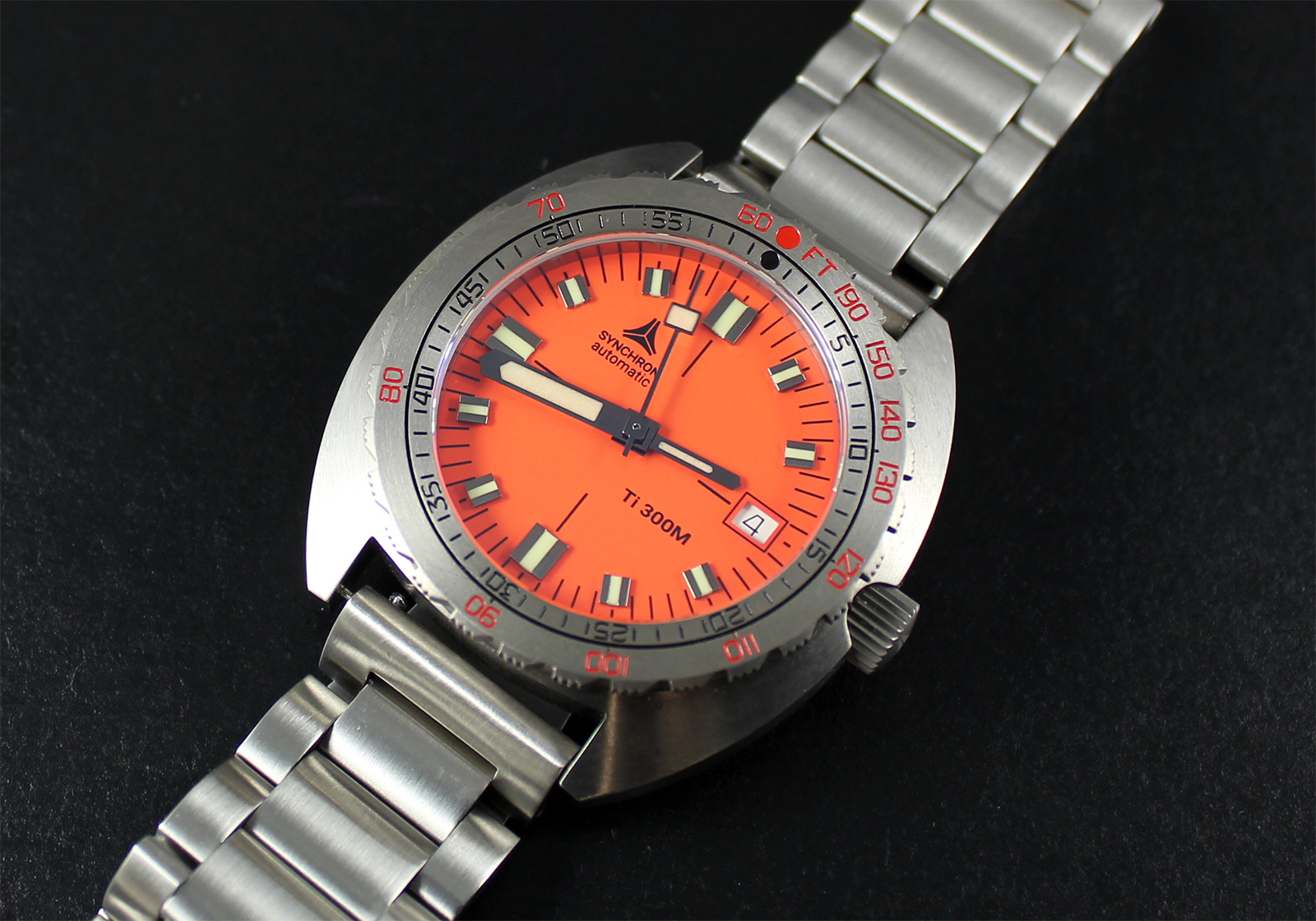
I did weigh just the Ti300M and SUB 300T watch heads for comparison and as can be seen the Ti300M is around 45% lighter.

The overall take away message here is that the Ti300M is significantly lighter than any of the other steel watches. Not really a surprise as titanium is around 45% lighter than steel. For the numbers guys out there: The density of the Grade 5 titanium alloy (Ti-6Al-4V) is about 4.4 to 4.5 grams per cubic centimeter (g/cm³). 316 stainless steel has a density of approximately 7.8 to 8.0 g/cm³. So titanium has a weight advantage. It also has superior corrosion resistance than stainless steel in a seawater environment especially where pitting and crevice corrosion is concerned. It is also harder and more scratch resistant. The commercial disadvantages are that it is more costly and more difficult to machine.
One thing worth noting here is that the Ti300M crown us a titanium cap on a steel crown. This makes sense when the stem tube is also stainless steel. Titanium to titanium threads are very prone to galling especially on small diameters. Titanium to stainless steel is much better but not as good as stainless to stainless.
The scratch resistance of titanium would be a welcome benefit for many DOXA SUB owners. The SUB bezel has long been described as a scratch magnet. The scratches are easy enough to polish out, however polishing removes metal and if you remove too much metal the paint in the numbers will be virtually impossible to repair. The following in a classic example of an over polished bezel. It has been polished so much that the edges of the outer numbers, especially the 80, have been obliterated. This means that you don’t stand any chance of successfully repainting the numbers and expect the paint to adhere or remain in place for any length of time.

Not only is the Ti300M bezel less likely to scratch, it also has a brushed finish. It is a 120 click bezel and it is tight and with no noticeable movement slop.
The above table has 2 numbers that are worth considering. The first is the case width. It measures 41mm which is 1.5mm less than that of the modern SUB 300T. This shrunken width also translates to a shorter lug to lug distance of 44mm. I’m going to be honest here and say that when I first handled the Ti300M prototype case last year, my first thoughts were why make it smaller by so little? It doesn’t actually look that different when put beside a 300T or 1200T (both watches use the same mid case). It’s not as if Synchron were trying to save weight by making the watch head smaller, they had already done that by using titanium. I also just got the case. There was no movement so the head was feather light. I really did think it was a bit of a misstep.

I gave Rick my thoughts on it and sent the case back and didn’t really think much more about it. That was until he sent me pics of the finished watch and said he was releasing it. I was surprised, but not as surprised as the price. He put the watch up for pre-order at $990. Yea, really $990. Comparing that to the price of a DOXA SUB 300T at $2,150 is jaw dropping. Probably not a surprise people beat a path to Synchron’s door to order one.

Dimension tables are nice but they just don’t tell the whole story. Take the Ti300M and the Benthos H2 for example. Similar sized watches and both wear remarkably well.

The Ti300M because of the lightness, the H2 because of the shape.
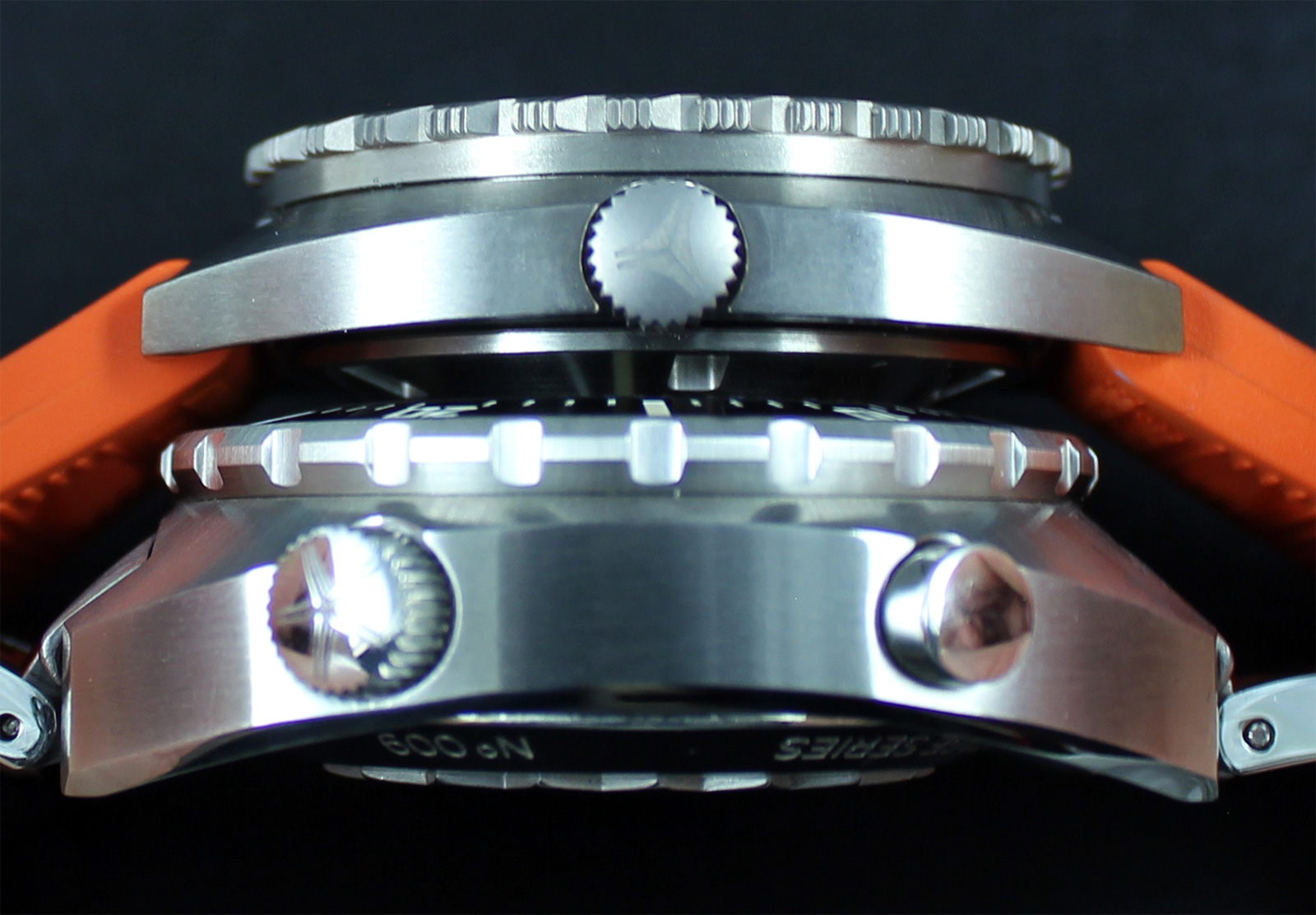
Then there is the comparison with the Ti300M and the SUB 1200T. From the top they both look similar,
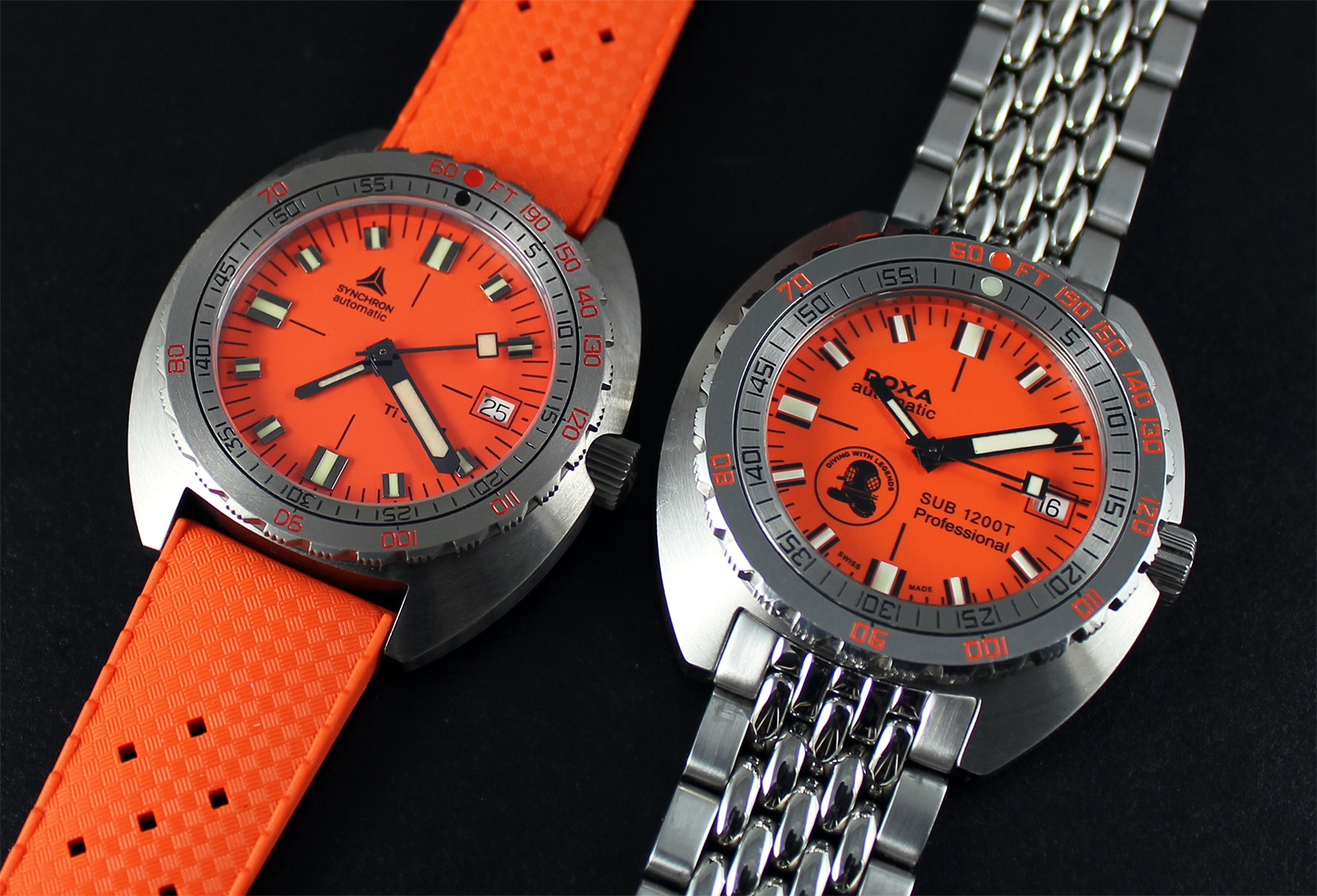
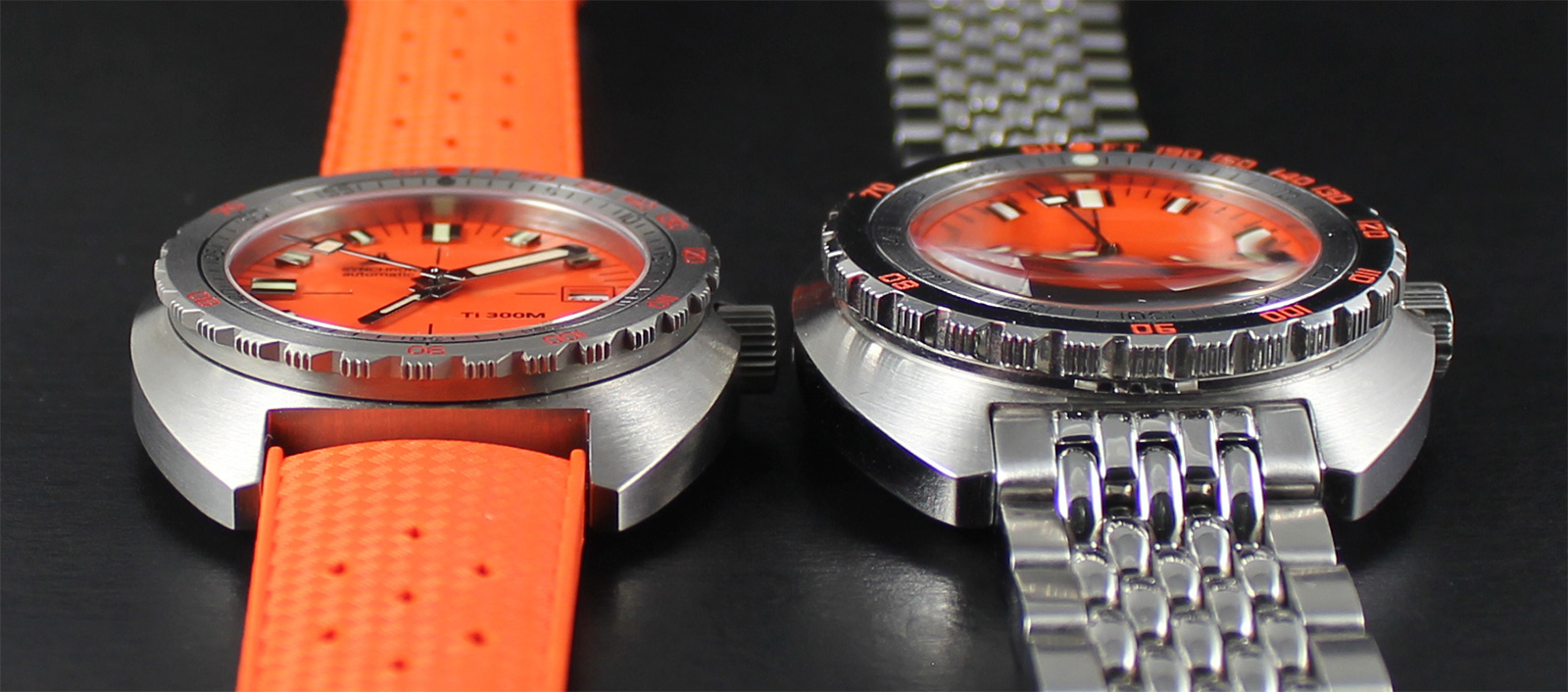
but change the angle and you can see not only the difference in height and bezel profile but also the effect a slightly domed crystal has.
Of course what I had forgotten was that over the last 2 years the watch world had started to swing its pendulum from hockey puck sized watches to small and slim watches. Everyone was getting in on the act. DOXA had come out with a 39mm SUB and even Breitling shrunk their classic 46mm Navitimer to 43mm. And that brings me to the second number: height of 11.9mm. Thin was in! I’ve bored people to death for years with my cry of “flat caseback.” During the Marei Era, DOXA had been making watches thicker just for the sake of it because big was the name of the game. They were increasing the thickness of the caseback just to add height to the watch. It didn’t make sense to me. I kept saying: make the caseback flat and thinner and the watch will wear better. I guess I was just at the wrong side of the pendulum swing, but it finally swung back.

The Ti300M hasn’t the flattest caseback I’ve ever seen but the fact the watch head is so light counteracts any wrist movement that would be seen with a more weighty head.

The Ti300M is particularly svelte with an 11.9mm thickness and that is a genuine height not the dodgy mid-case height some companies use when they have rather tall watches…cough, cough, I’m looking at you, Aquastar.
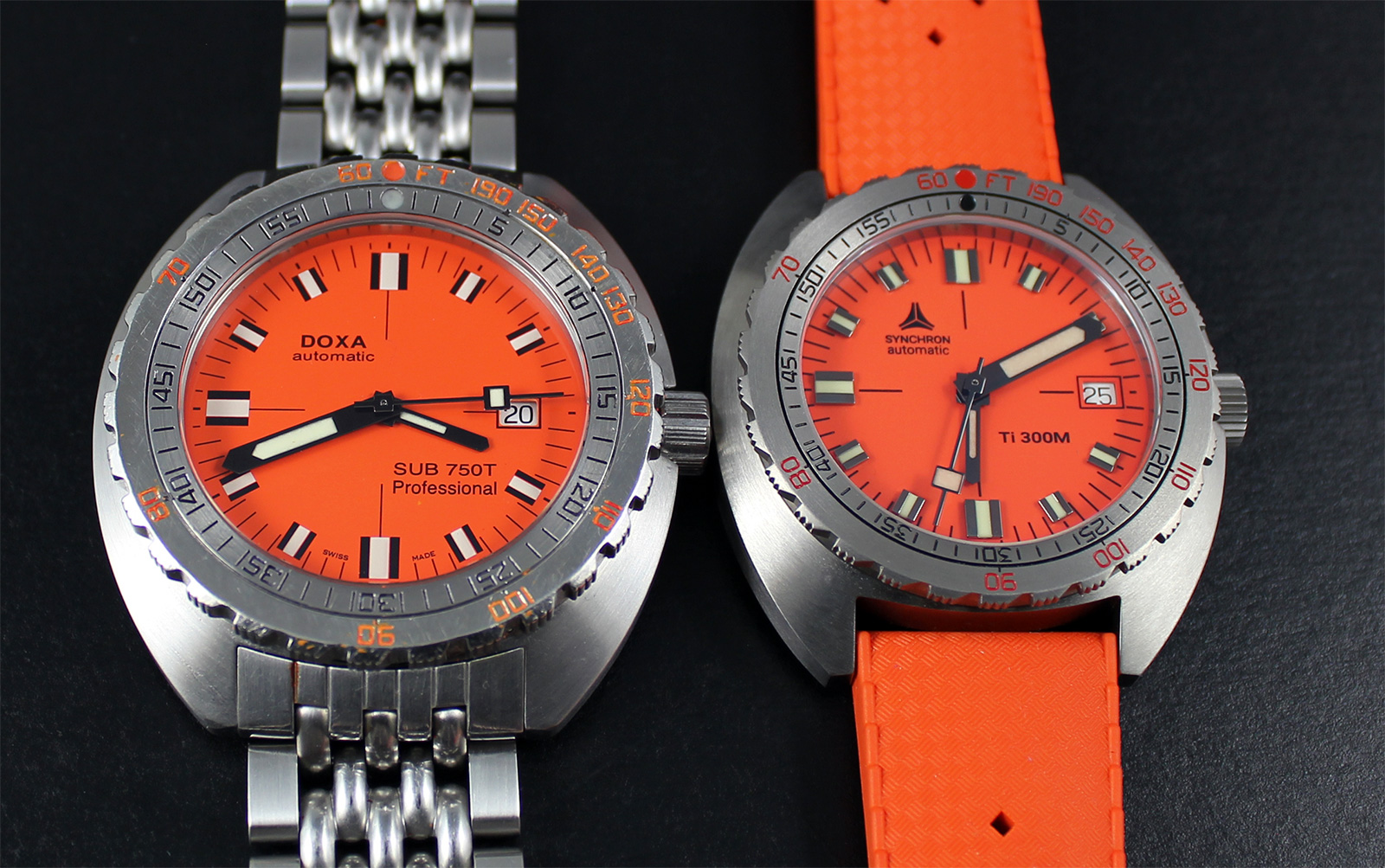
The one thing I think people will notice from my images is just how relatively large the Ti300M dial is. The actual visible area of the dial is 27.8mm in diameter. The comparison between the SUB 300 and it really makes the point.
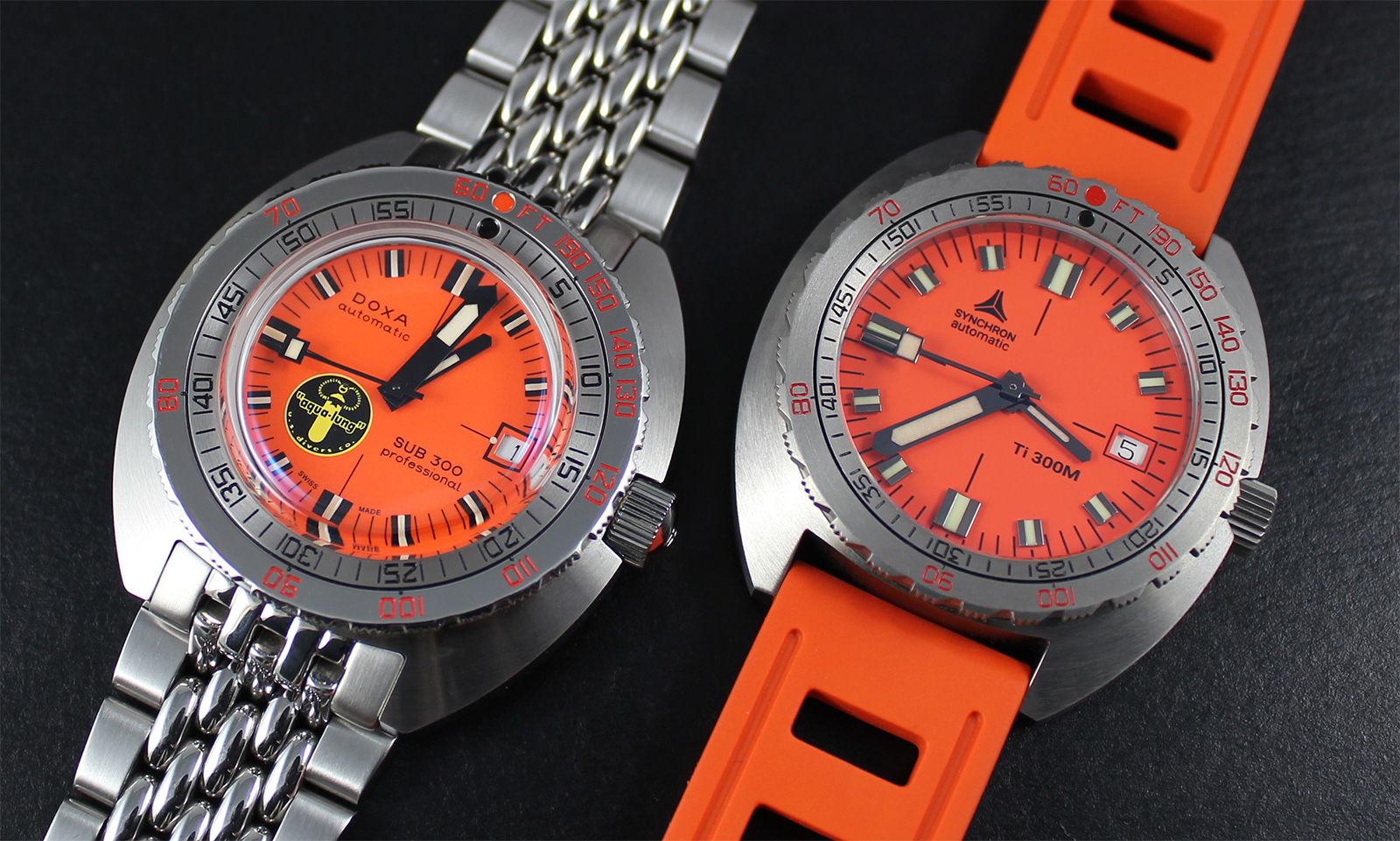
In fairness though the SUB 300 has a top hat crystal which distorts and optically shrinks the dial and the big orange dial win was unquestionably with another Marei Era SUB, the SUB 750T.
When I had the 300 and the Ti300M together I did a lume shot. Both exposed to 5 minutes of light. This is what they look like
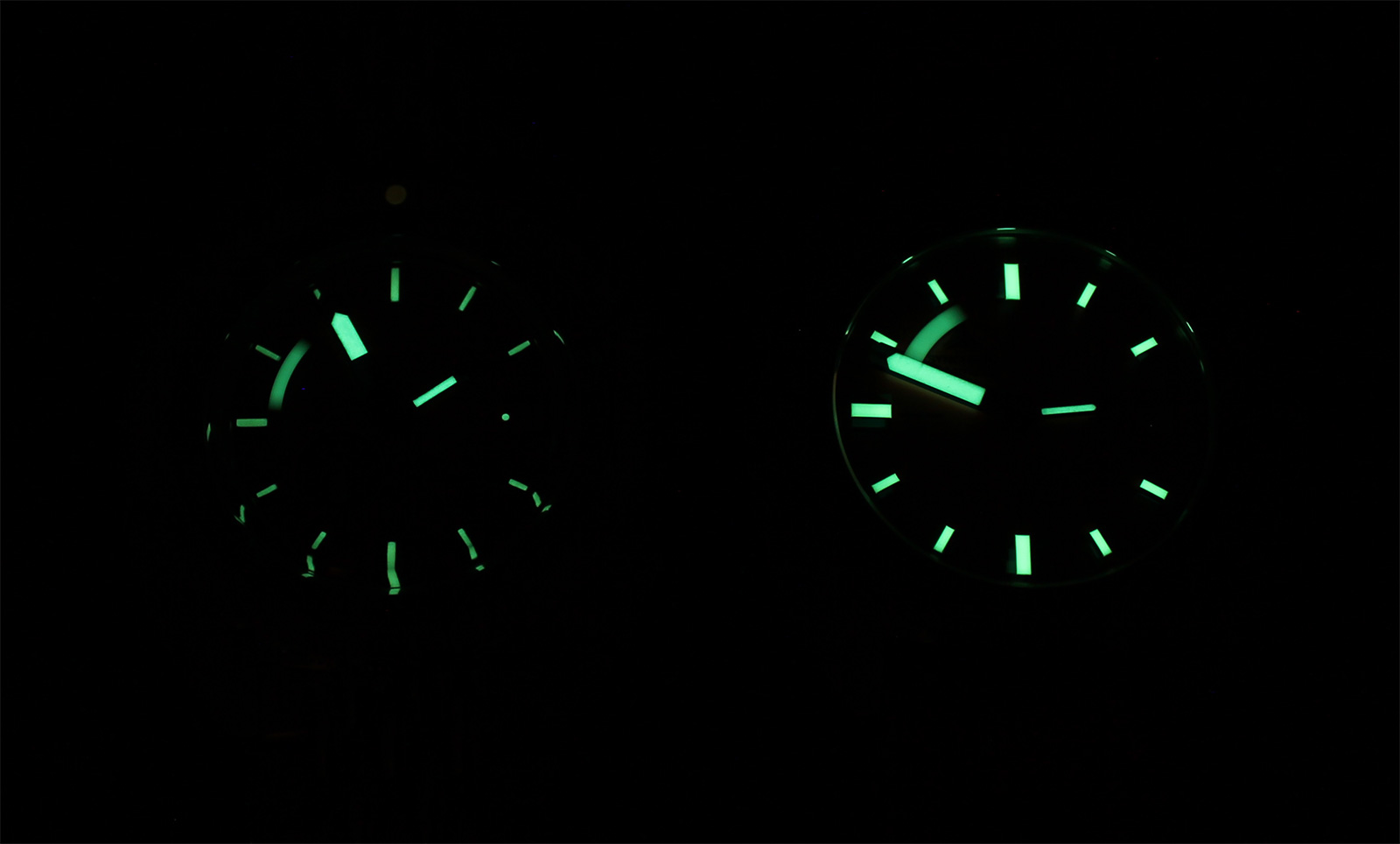
The lume on the DOXA SUBs has always been a point of criticism from the lume guys. Never bothered me as I never look at my watches at night in the dark. But, Synchron wanted to up the lume game on the Ti300M which is why they chose applied markers for the dial. A close up shows that you can pile a bunch more lume in. The thicker lume and the fact that it is the more energetic X1 C3 should make the dial glow stronger and longer.
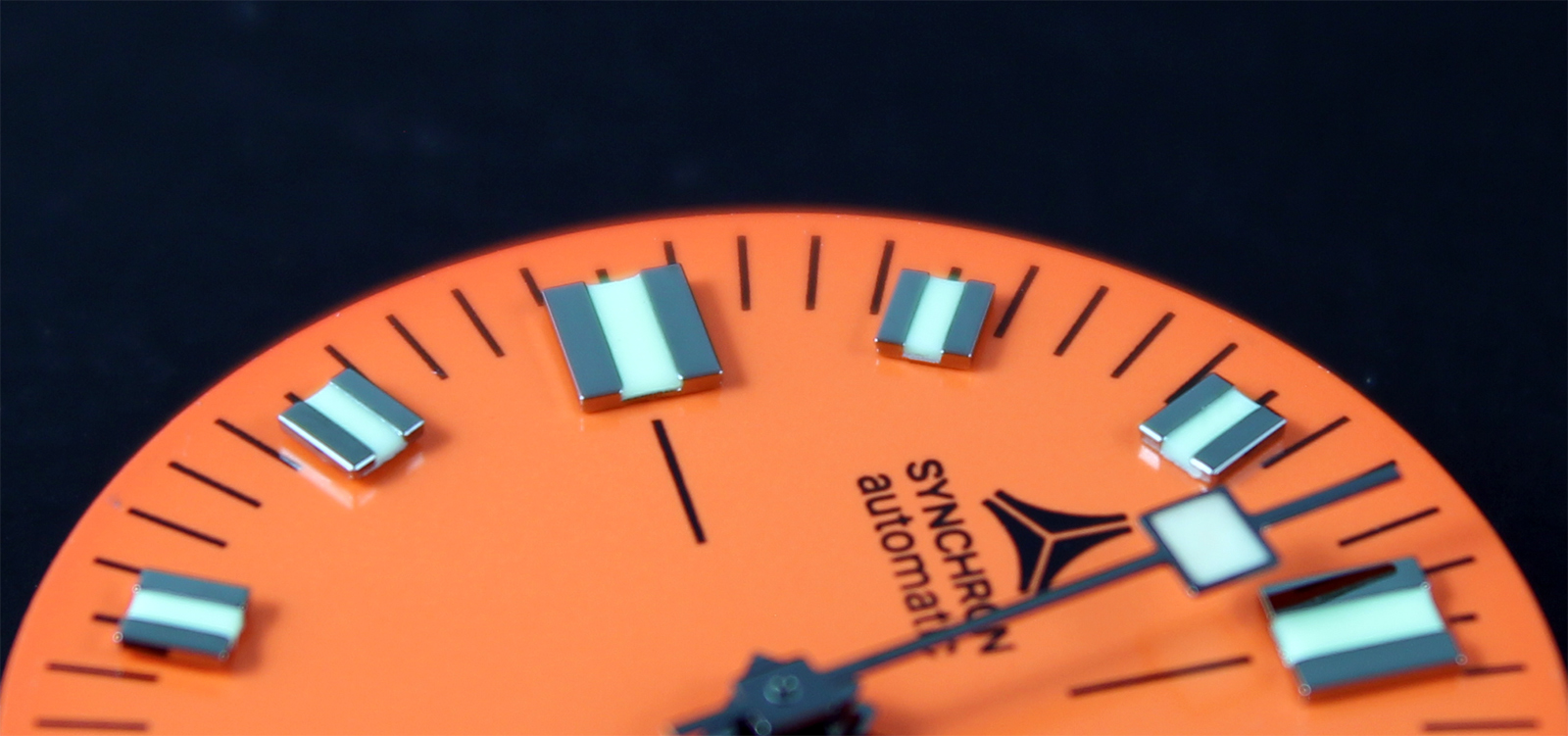
Actually talking of dials. One thing that I have to say is that the Ti300M uses a semi gloss paint and it was initially a really hard dial to photograph. For some reason the dial kept showing a light band of color around the outside. When I first saw the images of the watch on Synchron’s web site, I was very disappointed at the dial color, it looked washed out and when I started taking photos of this prototype the same happened. I honestly though all my pics were going to turn out really badly. It took a lot of fiddling with the lights and positions to try to get images that really showed the true color of the dial. And for those people who are wondering, yes the Ti300M and 750T dial colors are pretty close.
This is a pic of the Ti300M outdoors in direct sunlight.
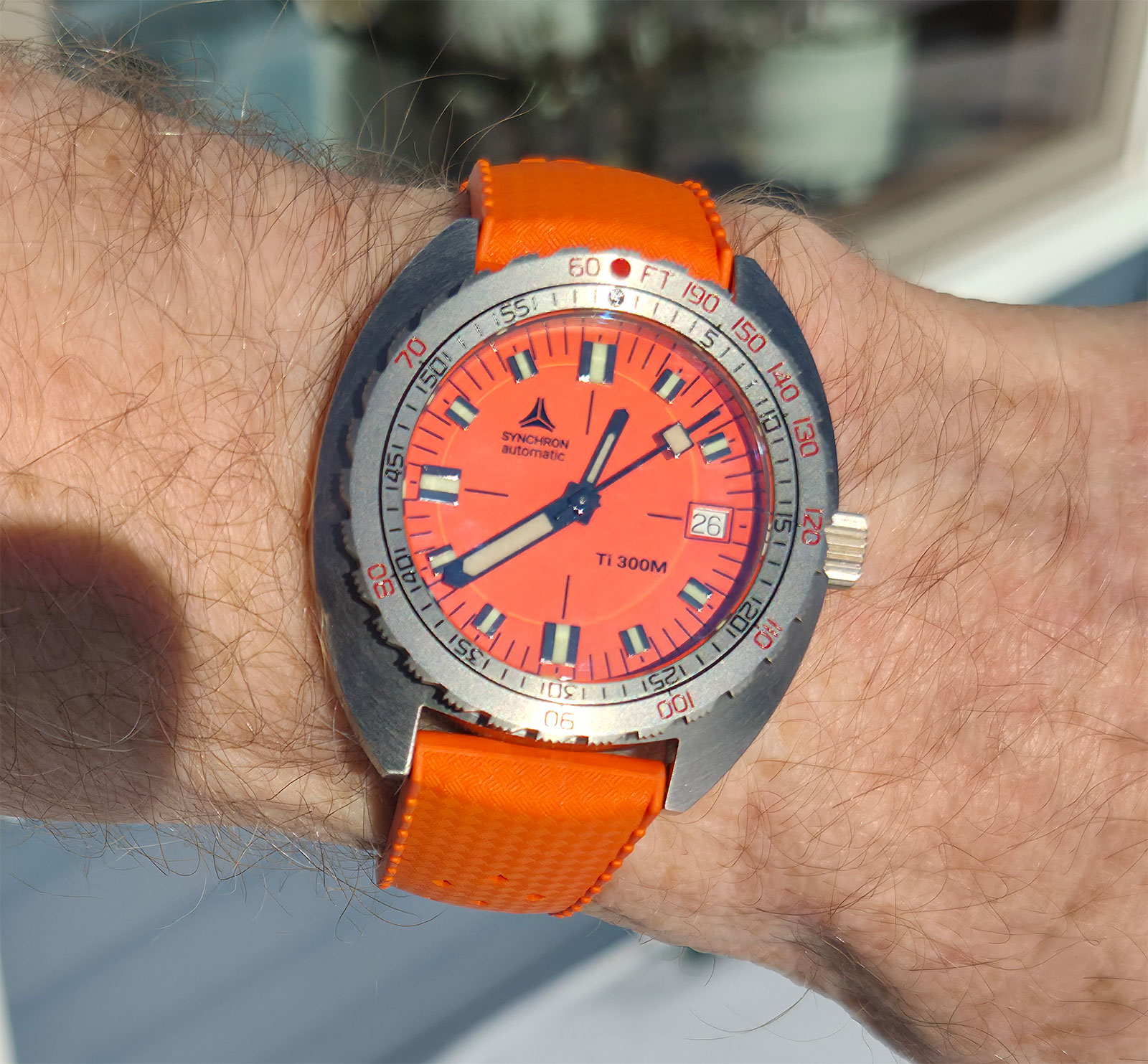
There is one other thing about the website images that need to be clarified. The hands color. They look like they are painted black in the images. Well, they are not. And no they are not silver like the indices either. Depending on the lighting the hands do a subtle change in color from jet black to a dark grey. When I noticed it happening I though my eyes were playing tricks. I looked closely at the hands and discovered that they weren’t painted. Instead it turns out that they are enamel coated like the dials of the Aquastar Benthos. I didn’t know that.
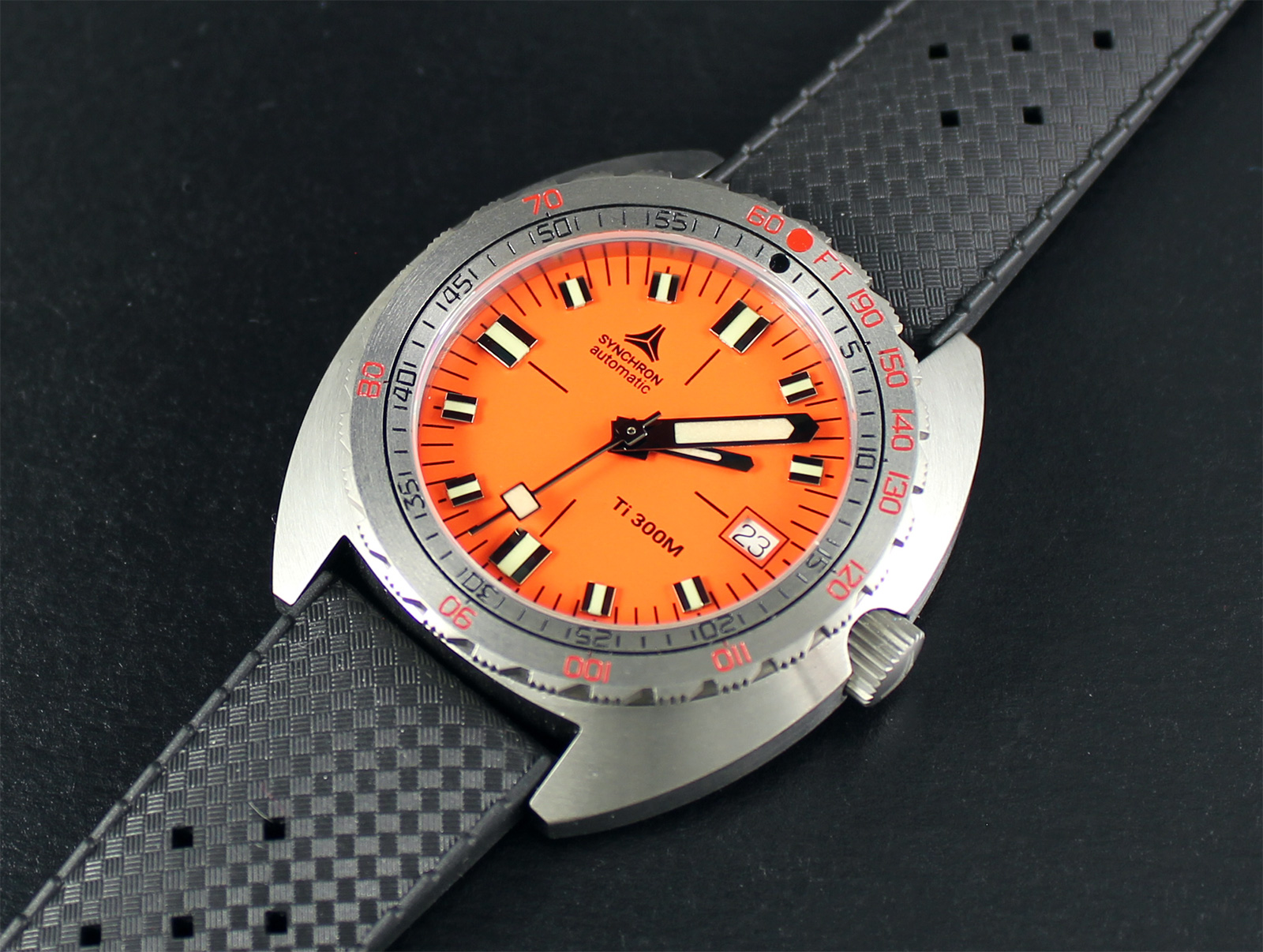
The more I look at the dial and hands the more I think it is just such a cool feature. The hands kind of mimic the same color of the indices depending on the light but still retain a shade of black instead of always being a jarring black against the metal indices. Look closely at the hands in the image above and below and you will see what I mean. It’s a definite win for me and is a nice little differentiator from the SUB 5000T which had similar metal markers but polished silver hands.

The Ti300M is powered by the La Joux-Perret G100 movement. The G100 was introduced in 2021. It is hand wind and automatic, hacks, 24 Jewels, runs at 28,800bph and has a 68 hour power reserve. It is dimensional compatible to ETA 2824-2 and Sellita SW200-1 (25.6mm diameter, same dial feet positions and the hand sets will fit as the dimension of the Cannon Pinion are the same). The G100 in the Ti300M is the highest grade available from LJP and is adjusted to 4 positions by LJP. It also has some innovations over the standard ETA 2824-2 and Sellita SW200-1. These include a rotor which is made from a solid piece of tungsten and turns on a ball-race held in place with 3 screws. Also a number of the wheels / cogs are made from CuBe (Beryllium Copper) and un-plated. The advantage of CuBe is that it work-hardens, is auto-lubricating and doesn’t tarnish. The shock protection for the balance pivots is made by Kiff, one of the two largest producers of shock protection in Switzerland. They were the shock protection supplier to Rolex until Rolex started making their own.

For those that don’t know LJP is owned by Citizen and the G100 is based on a Miyota 9015. There is no worry about servicing it in the future as many Miyota 9015 parts are interchangeable and are readily available.
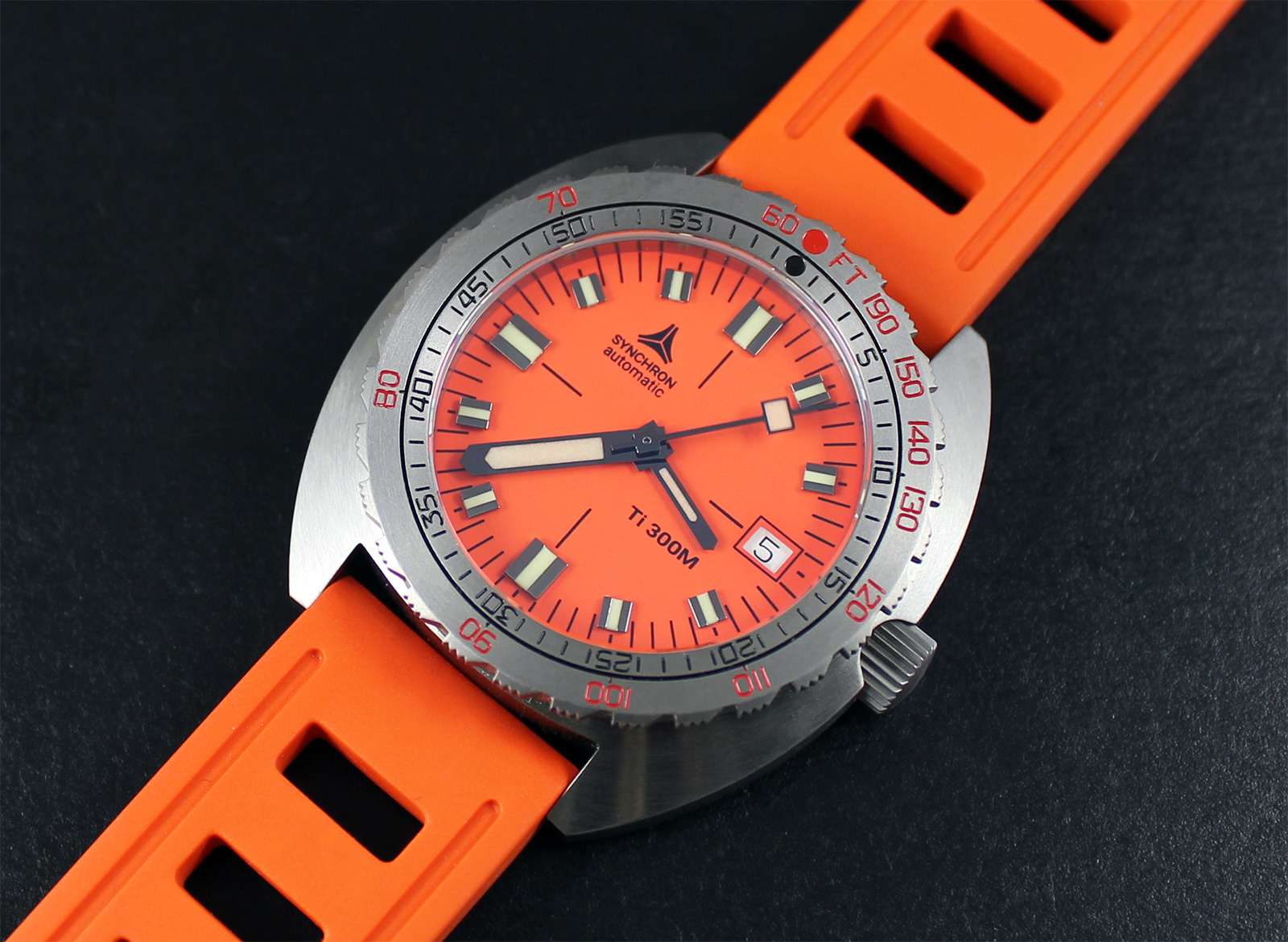
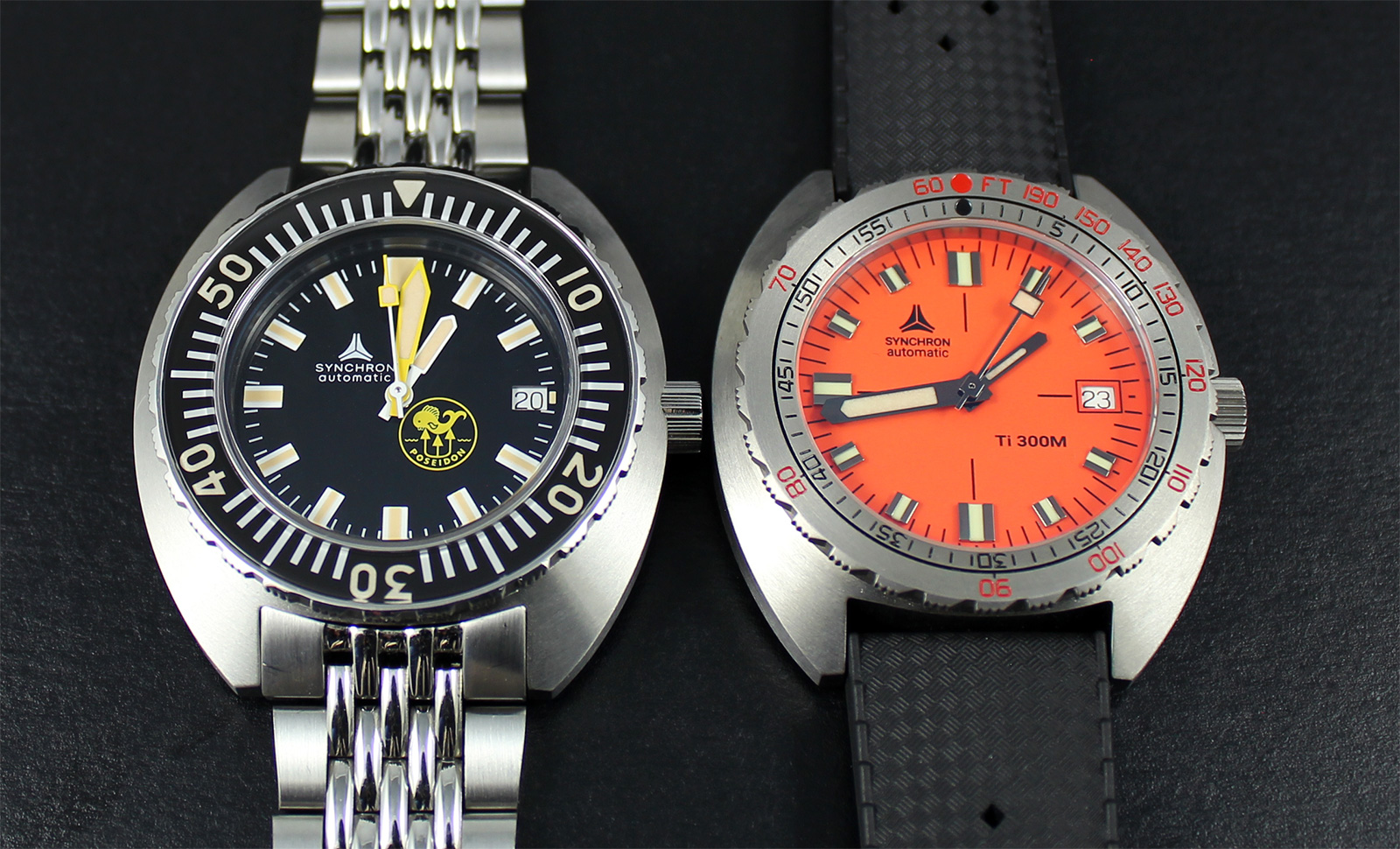
I have the orange and black Tropic straps and an orange Isofrane as can be seen in the images. My preference is the orange Tropic. It makes the watch positively glow on your wrist. It’s hard to stop looking at the combination. The Isofrane is nice too, but I feel it overpowers the Ti300M because is is thick and comparatively stiff compared to the Tropic. I think the Isofrane straps are better suited to heavier watch heads.
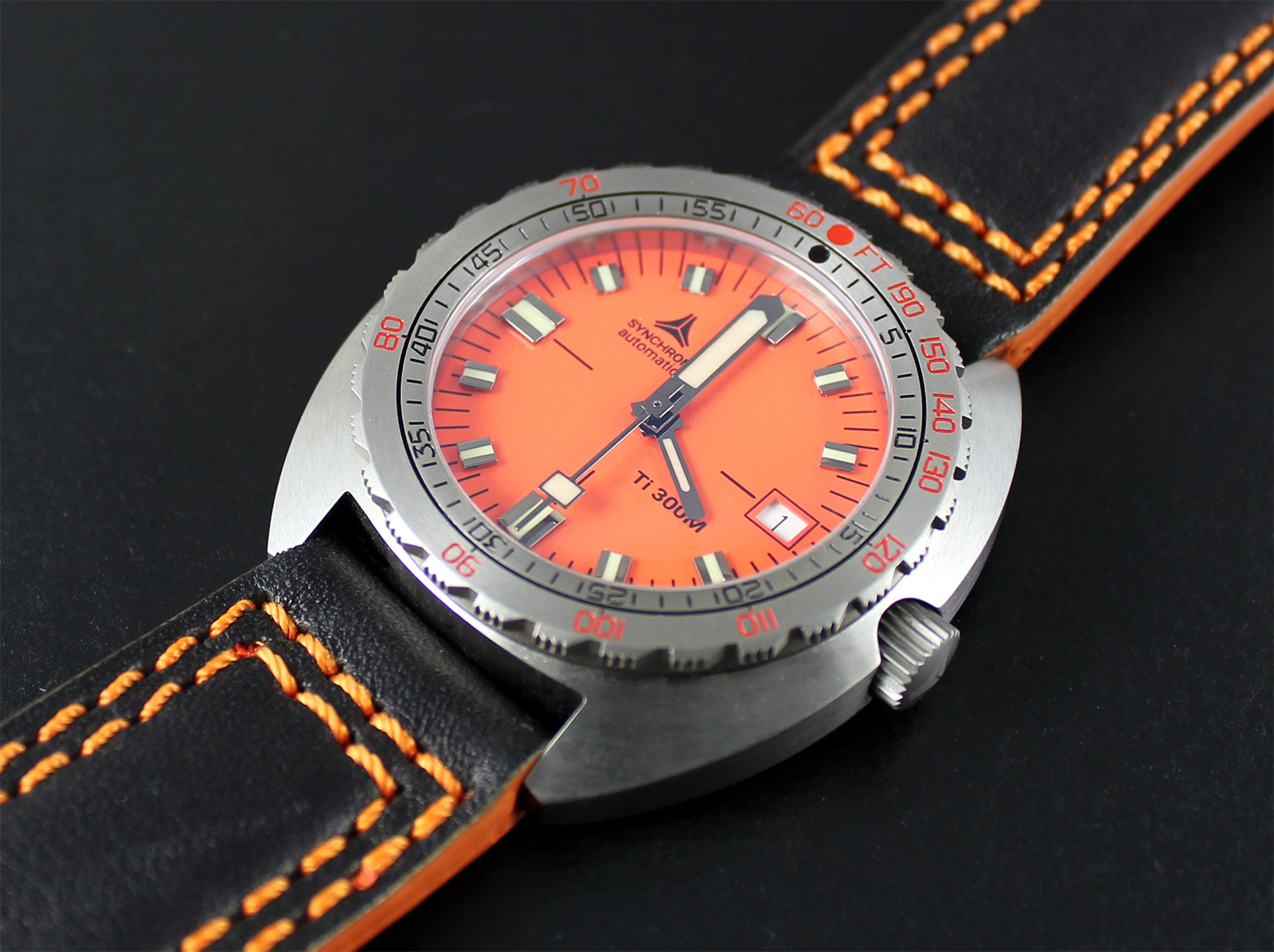
Is there anything I would have changed about the watch? Only one thing. I would have used the classic Synchron bezel with the longer minute marks. I feel that would have been a nice nod to the vintage Synchron Era SUBs.
After my initial hesitancy and preconceived “negativity” towards the titanium Synchron, I have to admit that the final version of the Ti300M really has won me over. I wonder if the titanium fan club guys will forgive me and let join. Please!!!!!
The Synchron Ti300M SEALAB is a Limited Edition run of 500. At the time of writing the first batch is sold old. It is available at the Synchron website: SYNCHRON